
We’re in Serbia now, we’re really moving along.

We started off with a tour of the Cathedral of St. Sava. We learned that this is quite a new Cathedral, and one of the biggest Orthodox church in the world (3,000 metres of floor and 79 metres high). It was supposed to be built starting in the mid 1930s but construction stopped when WWII started and it wasn’t finished until the mid 1980s.
During the war the partly built structure was used as a munitions depot for the Germans and Serbian partisans.
The name Saint Sava was chosen to honour the founder of the Serbian Orthodox Church, and a patron saint and national hero in Serbia. The walls and domes of the church are covered with mosaics that trimmed with 24 carat leaf embedded between pieces of glass. Everything glittered no matter which way we looked (the picture shows a bit of the dome behind the alter).
Our next stop was a cute little open air train ride through the Kalemegdan Fortress, that looks over the confluence of the Danube and Sava Rivers. We were told how this is a prized defensive location, because it sits high up on the hills. It was originally built in 279 BC, by a Celtic tribe, and has been taken over by Romans and others over the centuries. It was often destroyed and rebuilt (even after WWII bombing caused significant damage). Today it is a place to come and enjoy views of the city and a walk in park.

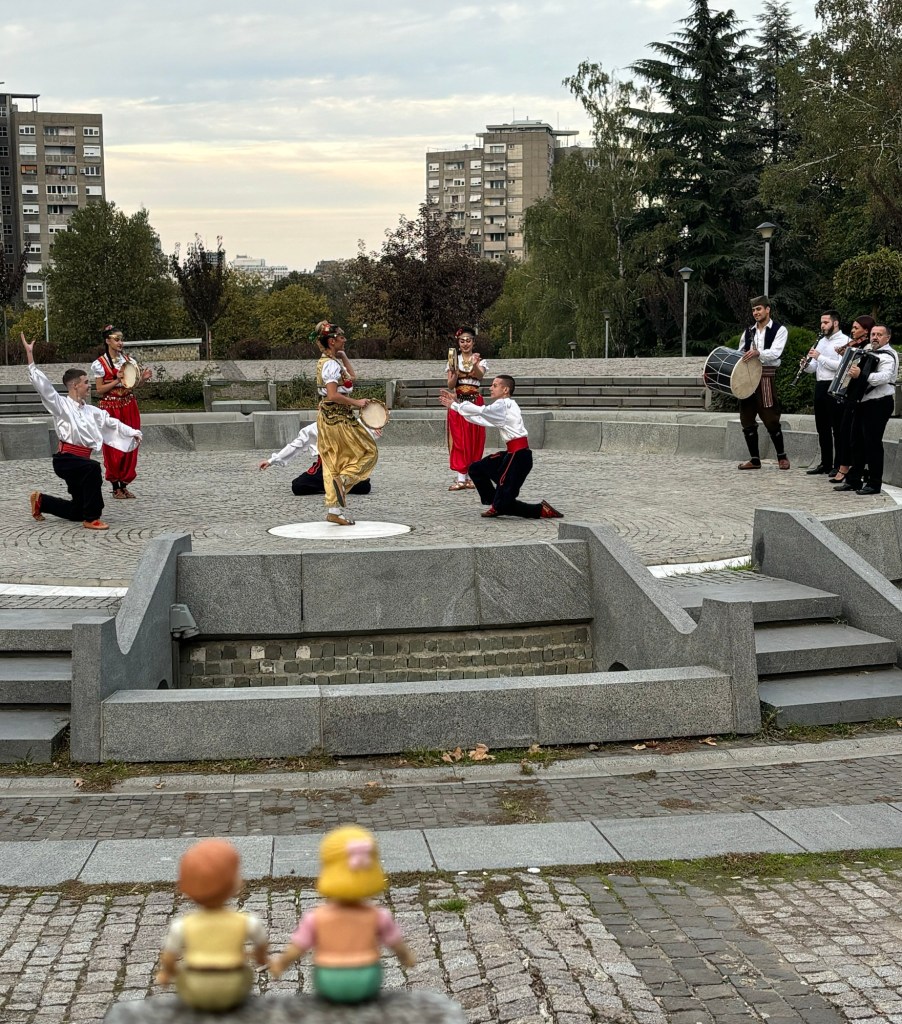
As we headed off for an afternoon tour we were surprised by a performance by some Serbian folk dancers. It’s a style of dance called ‘Kolo’ where the dancers link hands or arms making a chain as they dance. There were also some solo performances from the guys using sticks. The costumes were lovely and bright. Such fun!
Our last stop of the day was the memorial site for Tito. We learned that he was a very influential leader for Yugoslavia (Serbia, Croatia and Slovenes) in the 1900s. He joined the (illegal) Communist Party of Yugoslavia in the 1920s becoming its leader by 1937. He later led an uprising and socialist revolution.

After WWII when a new socialist state of Yugoslavia was being formed following the Soviet model Tito took control, breaking off from being subservient to Russia and created a separate socialist self-government style. It is said that Yugoslavia was the most democratic socialist governed country as a result of Tito’s leadership control. We heard conflicting opinions about the good and the not so good results. But he was certainly honoured in death, in 1980, with a monumental tomb that is still on display.
 Well Behaved Kids Travel